
In palmistry, the Marriage Line is one of the most commonly discussed markings on the hand. Many people look at this small line on the side of the palm and immediately ask questions such as:
When will I get married? Will I have one marriage or more? Will my relationship last? Is there a possibility of separation?
Traditional palmistry approaches these questions more carefully.
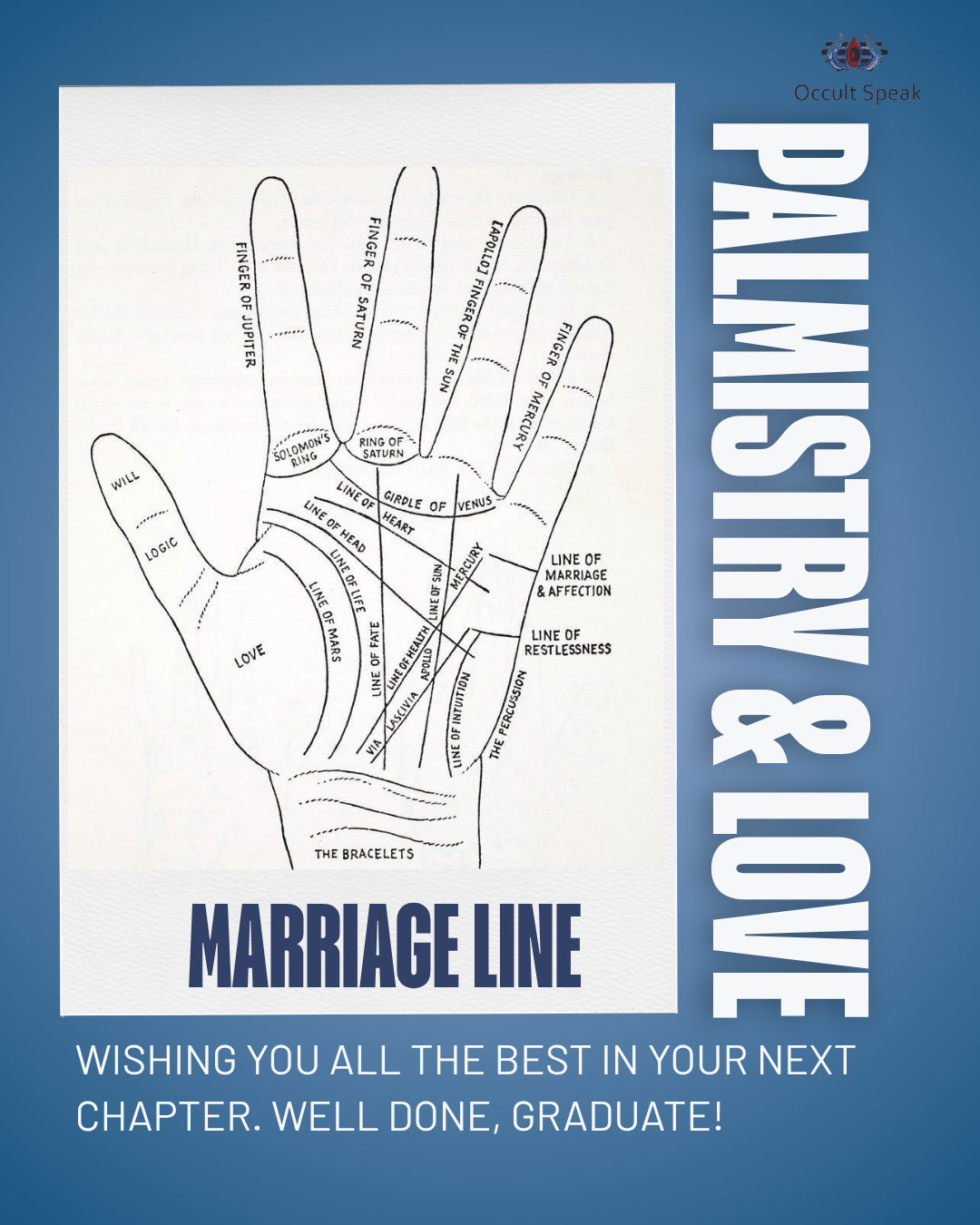
The marking commonly called the Marriage Line is traditionally located on the Mount of Mercury, beneath the little finger and above the Heart Line. Classical palmistry texts often refer to it as the Line of Affection, because the line is traditionally associated not only with marriage but also with significant emotional attachments and relationships.
The pages discussed in this article explain several characteristics that traditional palmists examine—including the depth, length, beginning, termination, forks, breaks, islands, crosses, dots and branches of the line.
Palmistry is a traditional divination practice and is not scientifically established as a method for predicting marriage or relationship outcomes. The interpretations below describe traditional palmistry principles rather than scientifically verified predictions.
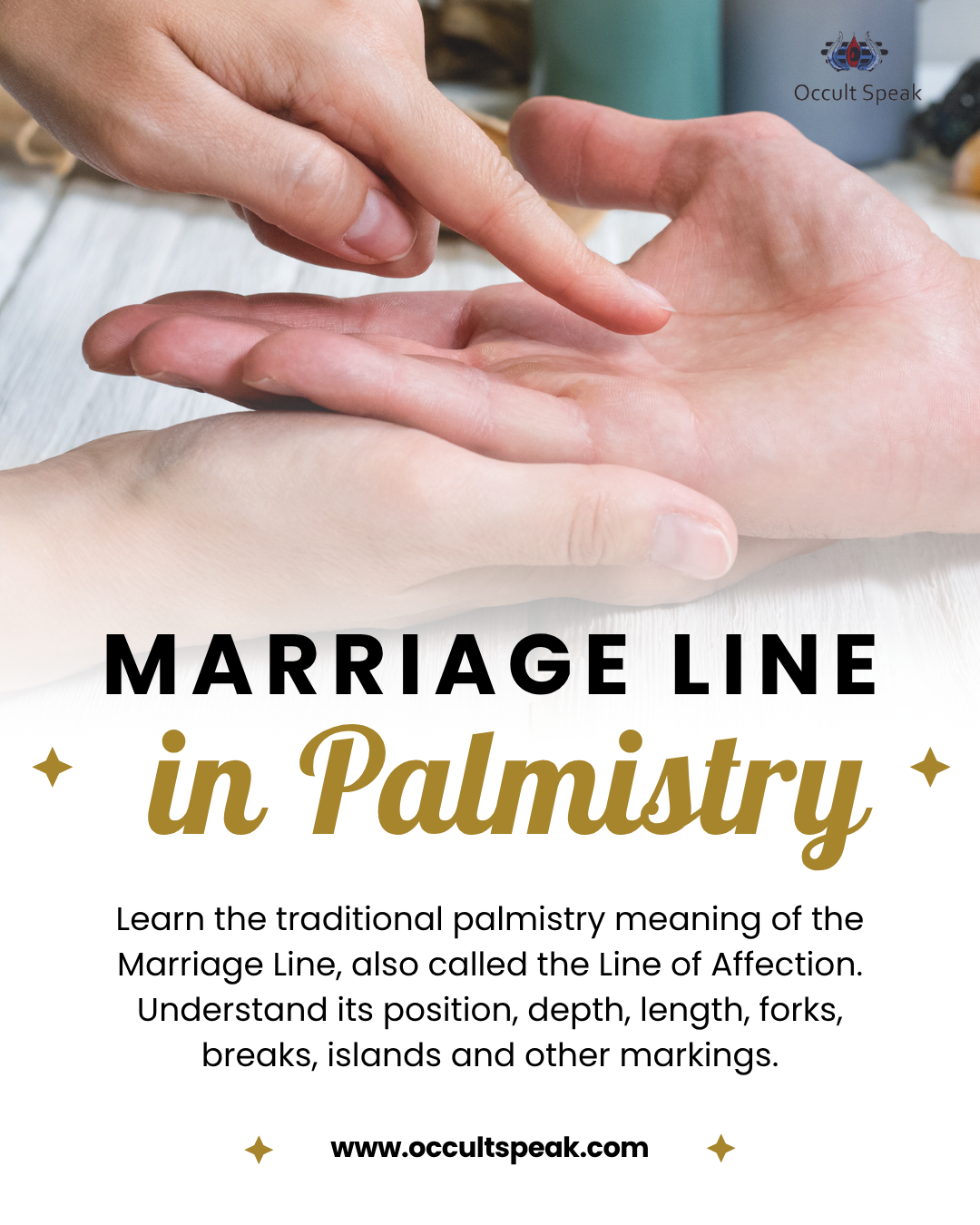
Marriage Line in palmistry
What Is the Marriage Line in Palmistry?
The Marriage Line, traditionally called the Line of Affection, is found on the outer edge of the palm beneath the little finger.
It generally runs inward from the side of the hand toward the Mount of Mercury.
Traditional palmistry considers these lines indicators of significant emotional attachments rather than automatically treating every line as proof of a legal marriage.
This distinction is important.
According to the traditional system described in the supplied text, a person may have a strong Line of Affection even when there has been no formal marriage. Therefore, simply counting these lines and declaring that someone will have a corresponding number of marriages is considered an unreliable approach within that particular palmistry tradition.
Marriage Line in palmistry
Where Is the Marriage Line Located?
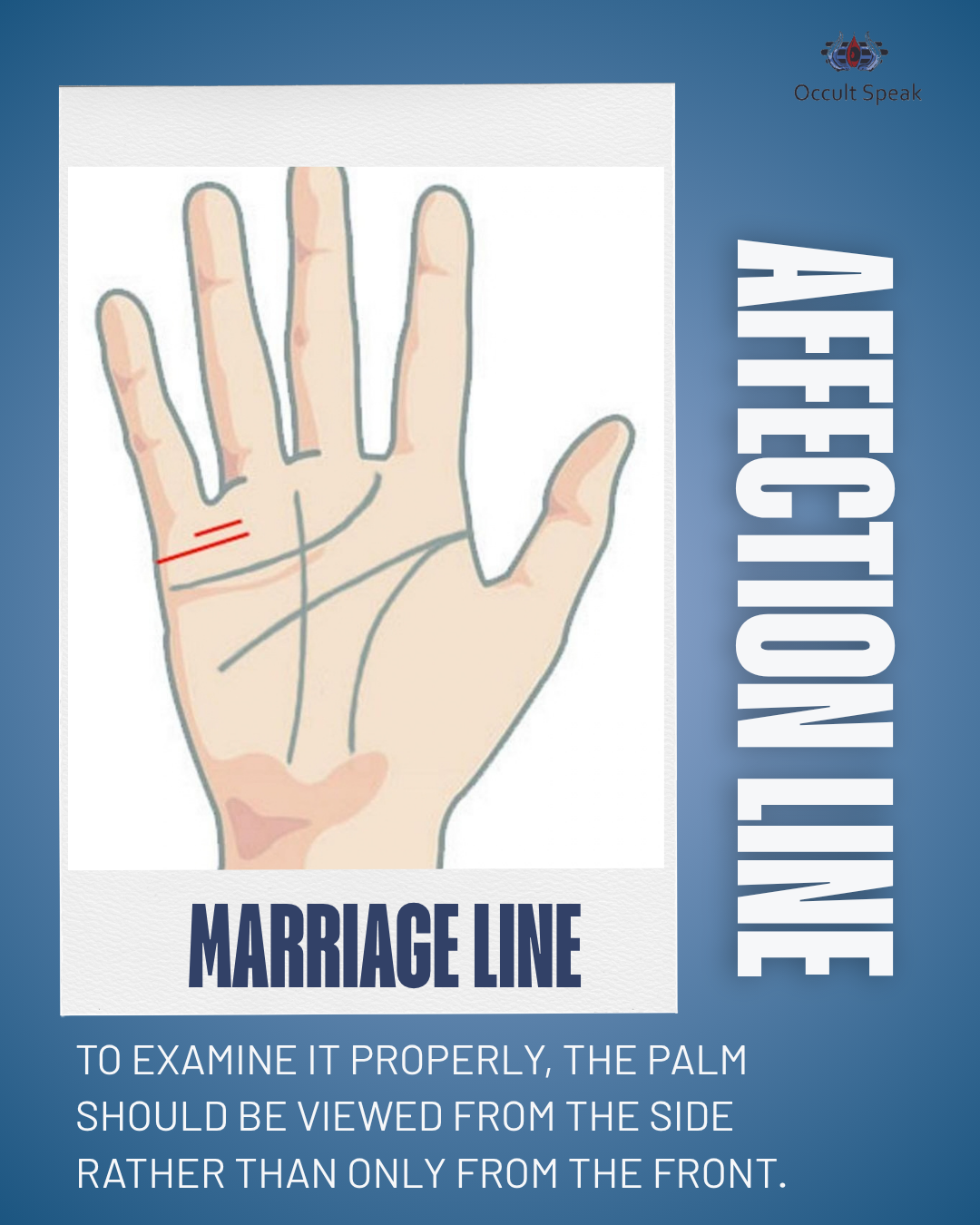
The Marriage Line is traditionally located:
- On the side of the palm
- Below the little finger
- On the Mount of Mercury
- Above the Heart Line
To examine it properly, the palm should be viewed from the side rather than only from the front.
Several short horizontal lines may sometimes appear in this region.
Traditional palmistry interprets these as Lines of Affection.
Why Is It Also Called the Line of Affection?
The term Marriage Line can be somewhat misleading.
The classical material you provided specifically explains that these markings should not automatically be treated as legal marriage indicators.
Instead, they are traditionally associated with the strength and significance of emotional attachments.
This means that:
- A strong line may traditionally indicate a deep attachment.
- A weaker line may represent a less intense attachment.
- Multiple lines may indicate multiple significant emotional experiences.
- The strongest line is traditionally given greater importance.
- Other palm markings are considered before making an interpretation.
Therefore, one should not simply count the lines and announce the number of marriages.
Marriage Line in palmistry
How to Read the Marriage Line
Traditional palmistry examines several characteristics of the Marriage Line.
The principal factors include:
1. Depth
How deeply etched is the line?
2. Length
How far does the line travel across the Mount of Mercury?
3. Beginning
Where does the line start?
4. Termination
How does the line end?
5. Direction
Does it remain straight, rise, descend or change direction?
6. Forks
Does the line divide into two branches?
7. Breaks
Is the line continuous or interrupted?
8. Islands
Are there oval or enclosed formations on the line?
9. Crosses and Dots
Are there disruptive markings?
10. Branches
Do branches rise from or descend from the line?
These features are traditionally interpreted together rather than independently.
What Does a Deep Marriage Line Mean?
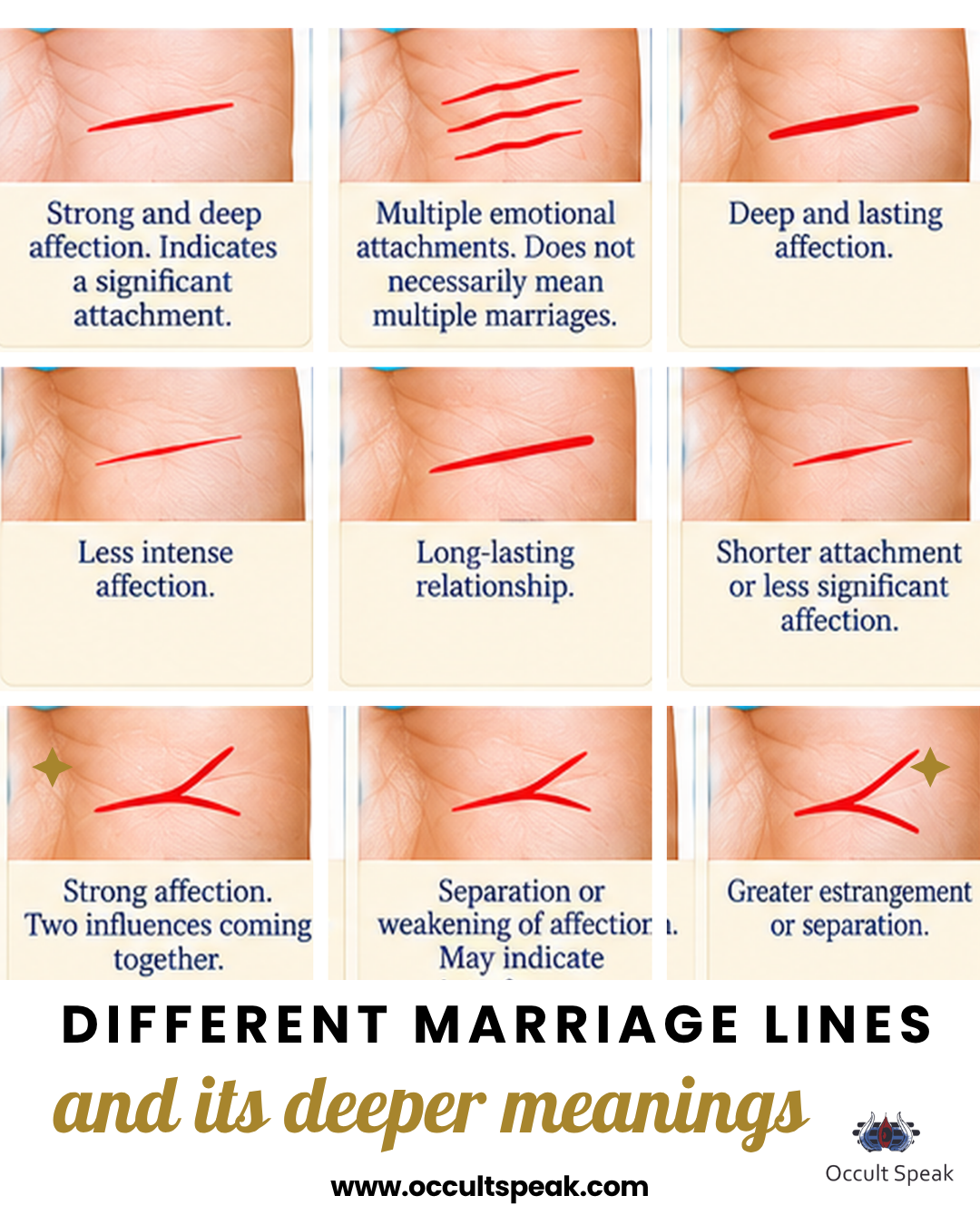
A deep and clearly marked Marriage Line is traditionally associated with a stronger emotional attachment.
The classical material describes deeply cut lines as representing deep and lasting affection.
A particularly strong line that continues clearly to its termination is traditionally interpreted as suggesting consistency and steadfastness in the attachment.
However, a palmistry reading should not be based on depth alone.
The Heart Line, Mount of Venus, Mount of Mercury and other relevant markings should also be considered.
Estimation of Marriage Age
What Does a Thin Marriage Line Mean?
A thin Marriage Line is traditionally associated with a less intense emotional attachment.
The supplied text distinguishes between the strength of the Marriage Line and the strength of other lines in the hand.
According to this traditional interpretation, when the affection lines are comparatively thin, the emotional attachment may not be the dominant feature of the person’s life.
Again, this should be interpreted as a traditional palmistry observation, not a factual prediction about someone’s emotional capacity.
What Does the Length of the Marriage Line Indicate?
Traditional palmistry also considers the length of the Line of Affection.
A longer, deeper and clearer line is traditionally given more importance than a short, faint marking.
The classical method described in the supplied pages uses both:
- Position to estimate the period at which an attachment occurs
- Length to estimate its duration
This is different from simply saying:
“Long line = long marriage.”
The traditional system is more nuanced than that.
Sign and Symbols on Marriage Line in Palmistry
Marriage Line Forks and Their Traditional Meaning
A fork is one of the most frequently discussed formations on the Marriage Line.
The supplied material describes several different forms of forks.
Fork at the Beginning
A fork at the beginning of the line is traditionally interpreted as indicating unusually strong affection, because two lines unite into one.
Fork at the Termination
A fork appearing toward the end of the line is traditionally associated with a separation or weakening of affection.
Older palmistry traditions sometimes associated this marking with divorce, but the text itself cautions against treating it as an automatic indication of divorce.
It can instead represent interference or diminishing affection.
Wide Fork
The wider the separation between the branches, the stronger the traditional interpretation of estrangement.
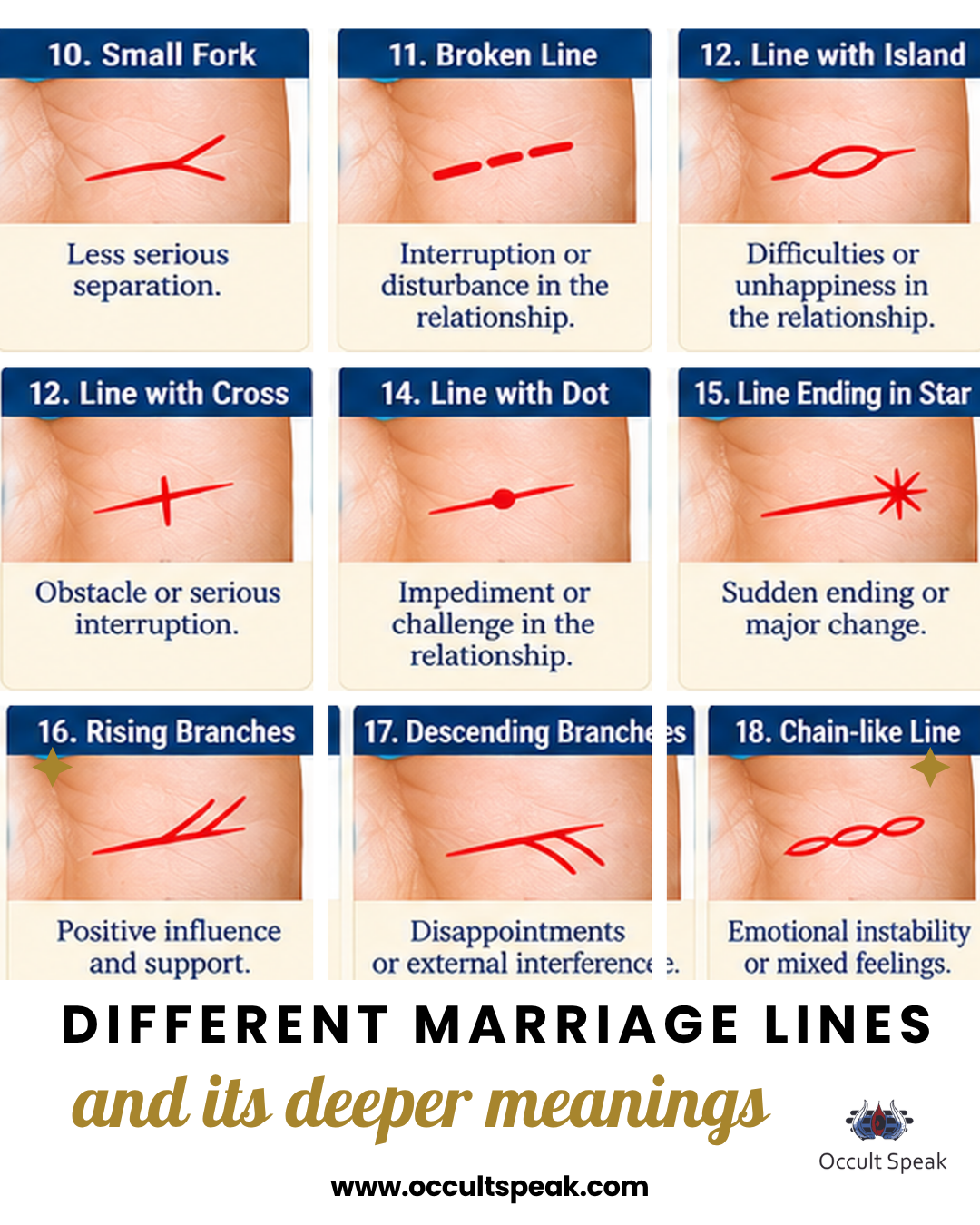
Small Fork
A small fork is traditionally interpreted as a comparatively less serious separation.
Broken Marriage Line in Palmistry
A break in the Marriage Line is traditionally considered an interruption in the course of an attachment.
The surrounding markings become important.
For example, the supplied material discusses:
- Breaks
- Repair markings
- Squares around breaks
- Hooks
- Dots
- Branches
A broken line surrounded by favourable repair signs is traditionally interpreted differently from a simple, uncorrected break.
This is why isolated interpretation of one marking can be misleading.
Sign and Symbols on Marriage Line in Palmistry
Island on the Marriage Line
An island is an enclosed oval-shaped formation appearing on a line.
Traditional palmistry associates an island on the Line of Affection with a period of difficulty or unhappiness connected with the relationship.
If the Line of Affection consists predominantly of islands, the traditional interpretation becomes considerably more complicated.
The important principle is that the palm should be read as a whole rather than assigning a fixed prediction to one island.
Cross, Dot and Other Markings on the Marriage Line
Classical palmistry gives considerable importance to markings that interfere with the Line of Affection.
Cross
A cross on the line is traditionally interpreted as a serious obstacle or interruption affecting the attachment.
Dot
A dot is traditionally associated with an impediment affecting the course of the relationship.
Star
The supplied text discusses a star appearing at the termination of the line as a particularly significant traditional marking.
Branches
Branches can have different meanings depending on whether they rise or descend.
Traditionally:
Branches rising from the line may be interpreted more positively, whereas branches descending from the line are associated with difficulties or disappointments.
Do Multiple Marriage Lines Mean Multiple Marriages?
Not necessarily.
This is one of the most important points in traditional Marriage Line reading.
A person can have several Lines of Affection without having several legal marriages.
The supplied classical text explicitly warns against treating the number of lines as an automatic count of marriages.
Instead, traditional palmistry considers:
- Which line is deepest
- Which line is longest
- Which line appears strongest
- The age at which it occurs
- Other markings
- The person’s overall hand type
- Supporting signs elsewhere in the palm
Therefore:
Three Marriage Lines ≠ automatically three marriages.
This is a useful distinction for anyone learning palmistry.
How Is Marriage Age Traditionally Estimated?
One of the more interesting techniques described in the supplied material concerns age estimation.
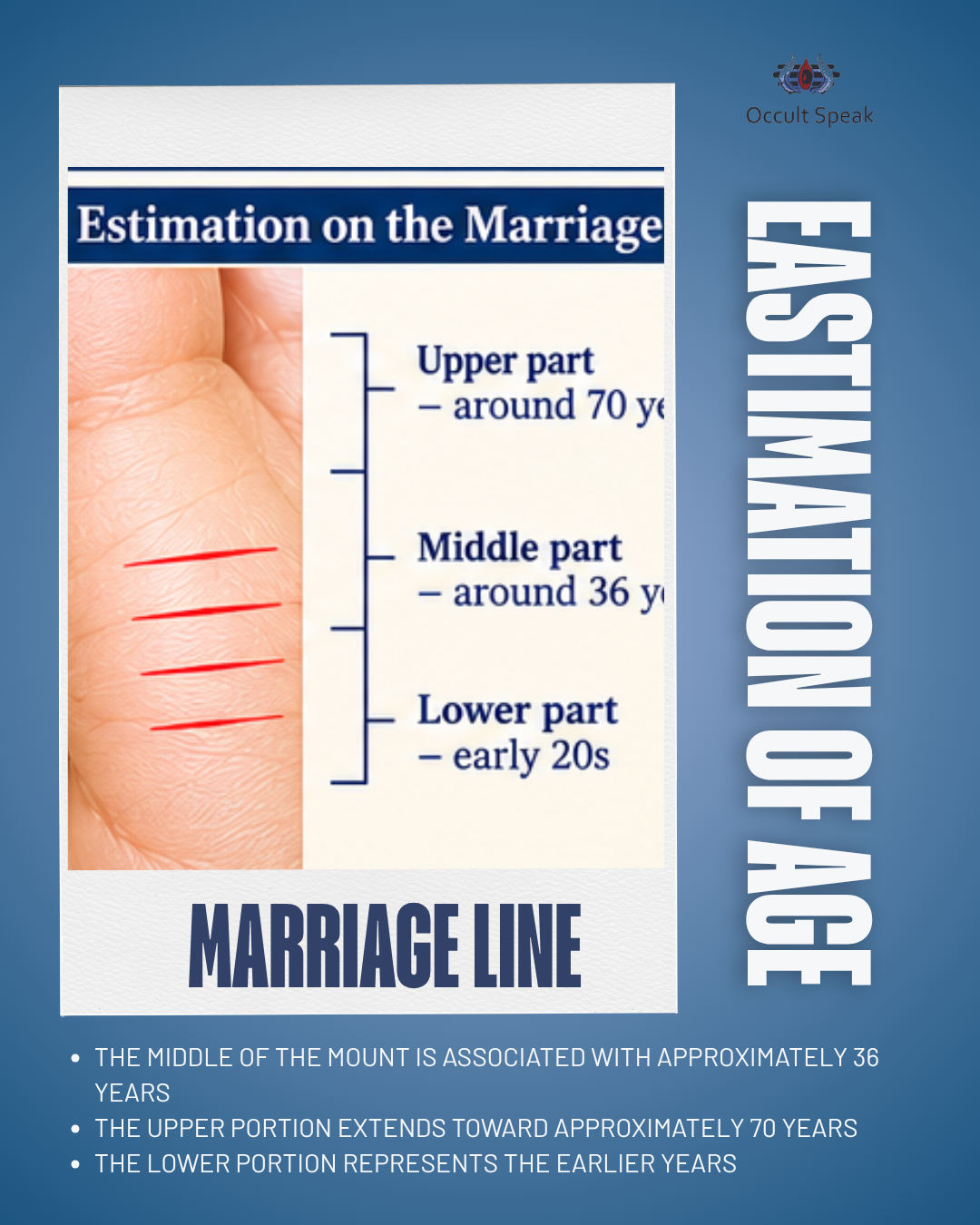
The traditional method uses the space between:
Heart Line → Mount of Mercury
This area is divided into an approximate age scale.
According to the method described in the traditional texts.
- The middle of the Mount is associated with approximately 36 years
- The upper portion extends toward approximately 70 years
- The lower portion represents the earlier years
The exact age is then estimated according to the position of the Line of Affection within this area.
The text also explains that the scale can be subdivided further when a more precise estimate is desired.
However, this should be understood as a traditional palmistry timing technique, not a scientifically validated method for determining the age of marriage.
Marriage Line and the Mount of Mercury
The Mount of Mercury plays an important role in traditional interpretation.
It is located beneath the little finger.
The Lines of Affection emerge from the side of the hand in this region.
The condition of the Mount itself may also influence interpretation.
A professional palmistry reading therefore considers the Marriage Line together with:
- Mount of Mercury
- Heart Line
- Mount of Venus
- Influence Lines
- Head Line
- Life Line
- Other significant markings
Marriage Line Should Not Be Read in Isolation
This is perhaps the most important lesson from the material you provided.
A Marriage Line should not be interpreted independently.
The supplied text repeatedly emphasizes the importance of combining the Line of Affection with other markings.
For example, influence lines from the Mount of Venus may interact with the Marriage Line.
These can traditionally be interpreted as external influences affecting relationships.
Similarly, markings that connect with other major lines can add context to the interpretation.
Therefore, an experienced palm reader doesn’t simply look at one small line beneath the little finger.
They examine the entire hand.
Marriage Line and Other Palmistry Signs
A comprehensive relationship reading may traditionally consider:
| Palmistry Feature | Traditional Area of Interpretation |
| Marriage / Affection Line | Emotional attachment |
| Heart Line | Emotional nature and relationships |
| Mount of Venus | Affection, vitality and attraction |
| Mount of Mercury | Communication and relationship expression |
| Influence Lines | External influences |
| Head Line | Mental approach |
| Life Line | General vitality and life pattern |
| Branches | Changes or developments |
| Islands | Periods traditionally associated with difficulty |
| Forks | Division or change |
| Breaks | Interruption |
These should be interpreted collectively rather than mechanically
Can Palmistry Predict Marriage?
Palmistry traditionally attempts to interpret relationship tendencies and significant emotional attachments through markings on the hand.
However, it should not be presented as a scientifically proven method of predicting:
- An exact marriage date
- The exact number of marriages
- The identity of a future spouse
- Guaranteed divorce
- Guaranteed relationship success
Human relationships are influenced by many factors, including personal choices, circumstances, communication, values and social environment.
Palmistry can be approached as a traditional interpretive practice and a tool for reflection, rather than as a certainty about the future.
Frequently Asked Questions About the Marriage Line
What is the Marriage Line?
The Marriage Line is a traditional palmistry marking found on the side of the palm beneath the little finger. Classical palmistry often calls it the Line of Affection.
Which hand should be examined for the Marriage Line?
Traditional palmistry practices vary regarding which hand should receive greater emphasis. A comprehensive reading generally examines both hands and compares them.
Do two Marriage Lines mean two marriages?
No. Traditional palmistry does not support simply counting Marriage Lines and equating them with the number of marriages.
What does a deep Marriage Line mean?
Traditionally, a deep and clearly defined line is associated with a stronger or deeper emotional attachment.
What does a forked Marriage Line mean?
A fork can have different interpretations depending on its position. A fork at the beginning and a fork at the termination are traditionally interpreted differently.
What does a broken Marriage Line mean?
Traditionally, a break can indicate an interruption or disturbance in an attachment. Other markings must be considered before interpretation.
Can the Marriage Line indicate the age of marriage?
Traditional palmistry uses the position of the Line of Affection on the Mount of Mercury to make an approximate age assessment. This method is not scientifically validated.
Conclusion
The Marriage Line, or Line of Affection, is a fascinating part of traditional palmistry.
Its interpretation goes considerably deeper than simply counting small horizontal lines beneath the little finger.
A traditional reading examines:
Depth + Length + Position + Forks + Breaks + Islands + Crosses + Branches + Supporting Lines
Most importantly, the Marriage Line should be interpreted in combination with the rest of the palm.
The classical material you shared also makes an important methodological point: a palm reader should avoid making absolute claims based on one marking alone.
For anyone studying palmistry, the Marriage Line is therefore best understood as one component of a larger system of hand analysis.
Let me know how did you find this blog on Marriage Line in Palmistry.
Love & Light,
Nirav Hiingu
Vedic Palmist

Leave a Reply