

What is 786 in Islam : The number 786 holds cultural, spiritual, and emotional importance in many Muslim communities, especially across South Asia. But what is the real meaning of 786 in Islam?
Is it divinely endorsed or a cultural creation? Let’s explore the origins, symbolism, scholarly views, and associated misconceptions of this intriguing number : What is 786 in Islam.
What is 786 in Islam V/s Numerical Representation of the Bismillah
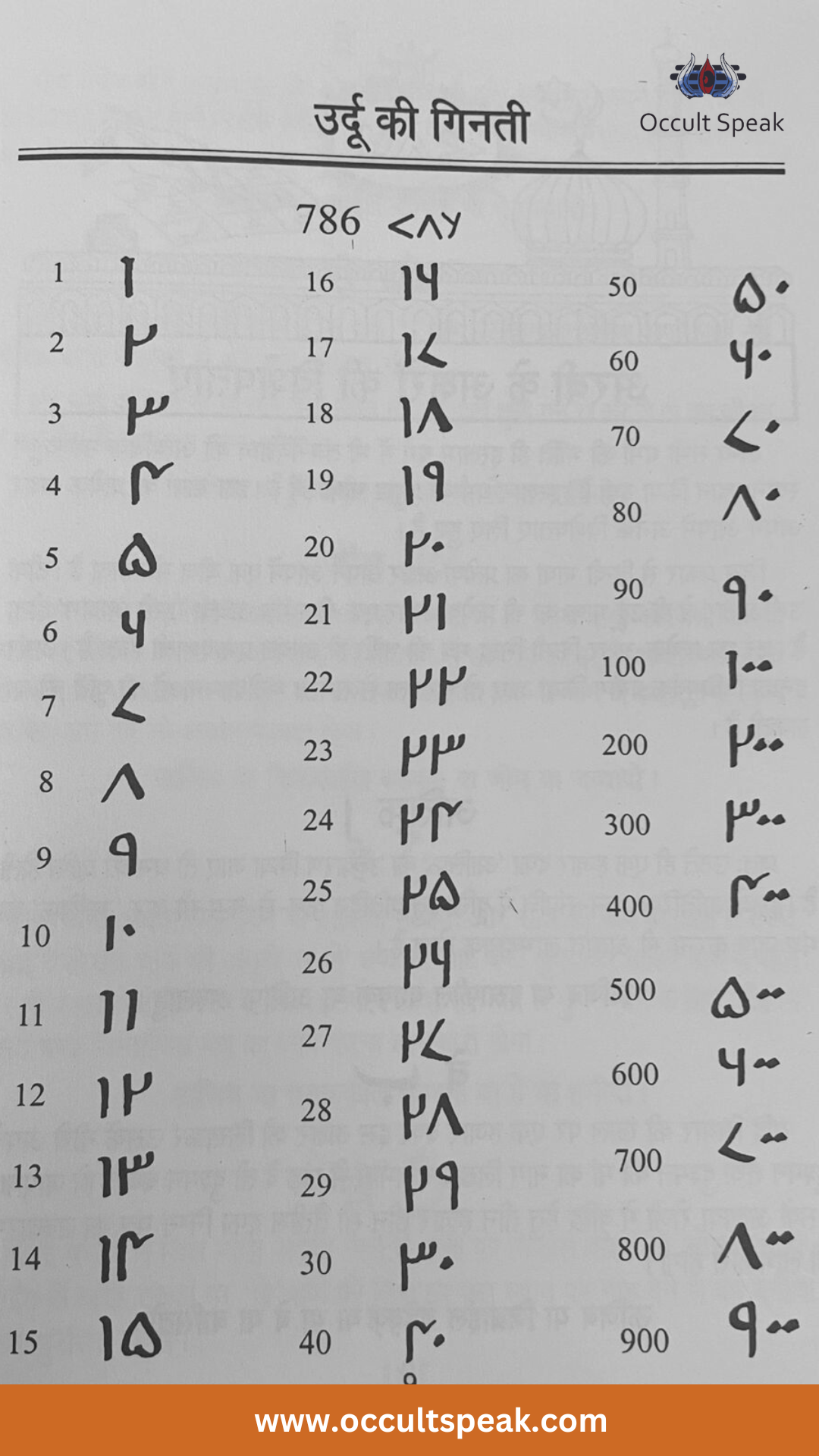
The most widely accepted explanation for 786 in Islamic culture is that it represents the phrase “Bismillah al-Rahman al-Rahim” — “In the name of Allah, the Most Gracious, the Most Merciful.”
This association comes from the Abjad system, an ancient method of assigning numerical values to Arabic letters. When the values of each letter in this sacred phrase are summed using this method, they total is 786.
What-is-786-in-Islam-Arabic-Islam
The Abjad System – What is 786 in Islam
The Abjad system traces back to early Semitic traditions, including Phoenician and Aramaic scripts, and was formalized during the ‘Abbasid period (circa 9th century CE). It provides each Arabic letter a numerical value from 1 to 1000.
While the system itself has linguistic and poetic uses, applying it to derive hidden meanings in scripture is not a mainstream Islamic practice.
Scholarly Perspective – Is 786 Endorsed in Islam?
Lack of Prophetic or Sahabi Usage
There is no evidence that the Prophet Muhammad (peace be upon him) or his companions (Sahabah) ever used 786 as a substitute for the Basmalah.
Islamic scholars emphasize that while the number may symbolically represent reverence, it has no foundation in authentic Islamic teachings or jurisprudence.
According to Surah Al-Maida (5:3) :
“This day I have perfected for you your religion and completed My favor upon you and have approved for you Islam as your religion.”
This verse reinforces that Islam was completed during the Prophet’s lifetime. Any addition or alteration in rituals or symbols — including the numerical substitution of divine phrases — may fall under the category of Bid’ah (innovation), which is generally discouraged or outright rejected in Islam.

Surah Al-Maida (5.3)
Cultural Use of 786 in South Asia ( What is 786 in Islam )
Respectful Substitution or Superstition?
In India, Pakistan, and Bangladesh, many Muslims use 786 as a shorthand for writing “Bismillah” — especially on invitations, wedding cards, and business documents.
The intent is usually out of reverence, avoiding writing Allah’s name on materials that may be discarded. However, scholars caution against replacing sacred text with numbers, as it may lead to distortion or loss of spiritual understanding.
What-is-786-in-Islam and Hindu Dharma
786 in Other Traditions – Connections Beyond Islam
Interestingly, the number 786 is also seen in Hindu spirituality and numerology, drawing parallels across faiths — although these connections are more symbolic than doctrinal.
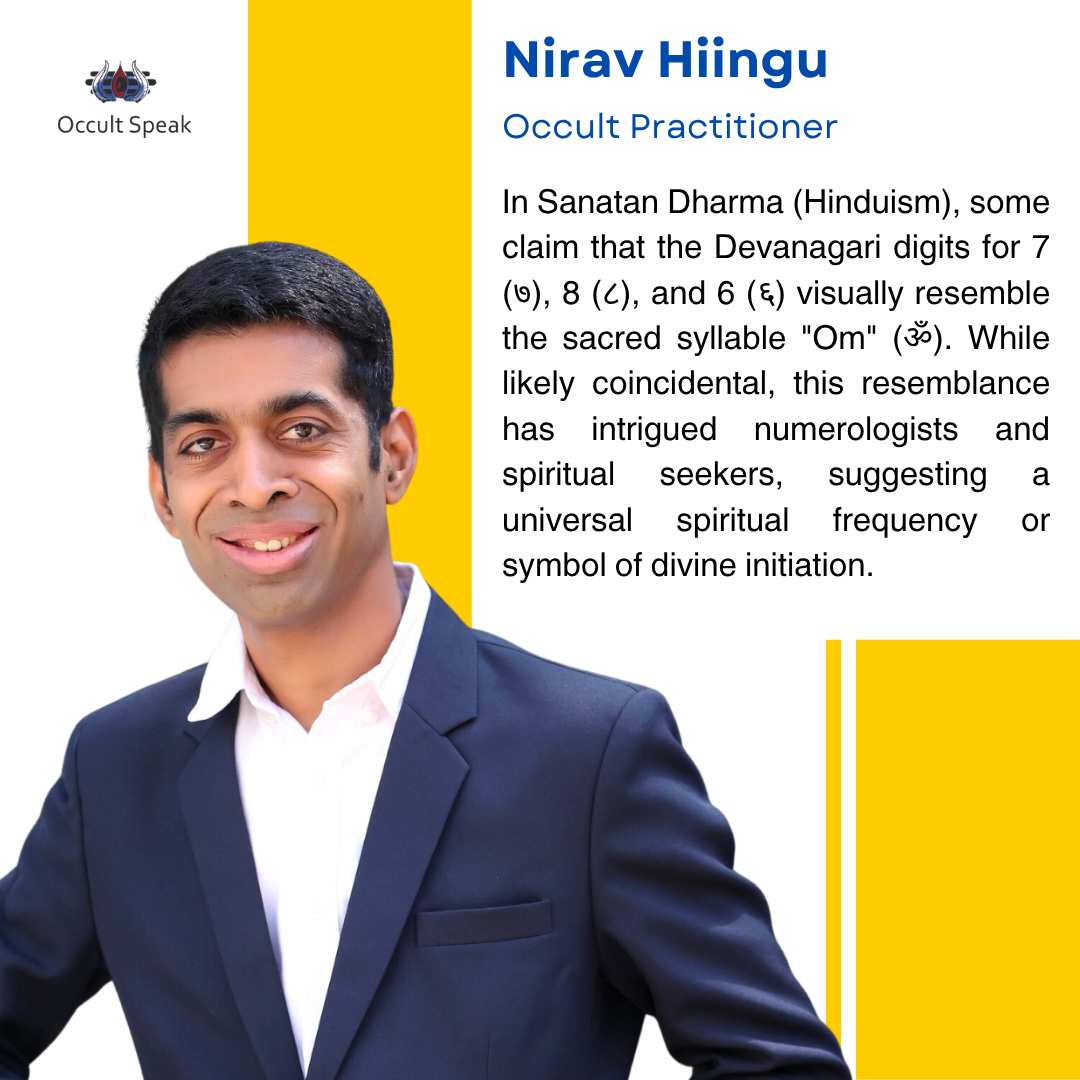
786 and the Om Symbol (ॐ)
In Sanatan Dharma (Hinduism), some claim that the Devanagari digits for 7 (७), 8 (८), and 6 (६) visually resemble the sacred syllable “Om” (ॐ). While likely coincidental, this resemblance has intrigued numerologists and spiritual seekers, suggesting a universal spiritual frequency or symbol of divine initiation.
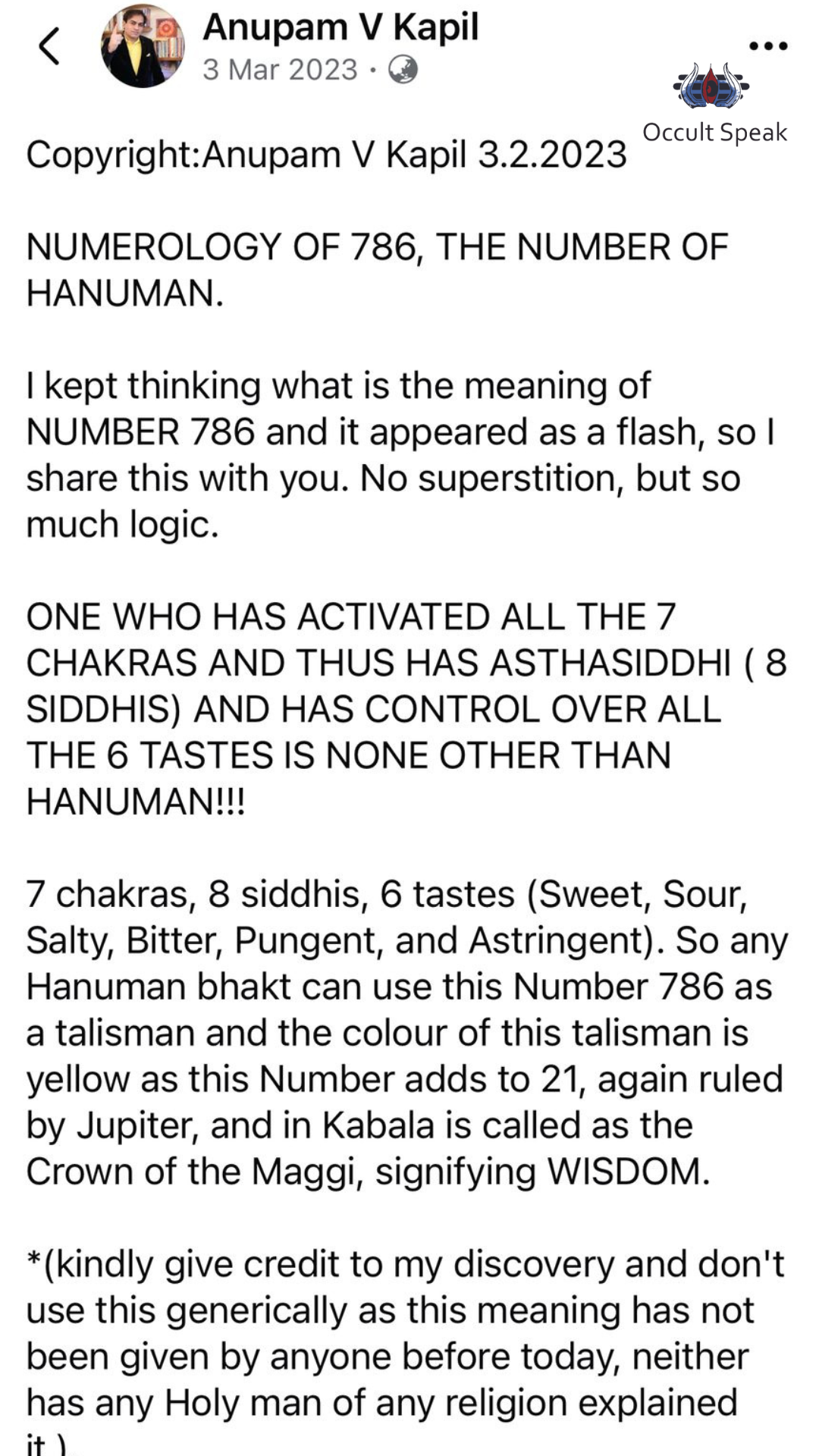
Numerological Interpretation with Hanuman Ji by Anupam V Kapil
According to Numerologist Anupam V Kapil, 786 reflects Hanuman Ji — the awakened being who:
- Has activated all 7 chakras
- Possesses the 8 Ashtasiddhis
- Mastered the 6 tastes of life
Thus, in this view, 786 becomes a numerical embodiment of divine power and discipline. I have attached his facebook post dated 3rd February 2023 for the reference.
Symbolism of 7, 8, and 6 in Sanatan Dharma
- 7 (Seven): Refers to seven sages (Saptarishi), seven musical notes, seven underworlds, and more.
- 8 (Eight): Signifies Ashtasiddhis, eight limbs of yoga (Ashtanga), eight forms of Shiva.
- 6 (Six): Associated with six chakras, six Vedangas, and six flavors (Rasa) in Ayurveda.
These interpretations give 786 a rich symbolic narrative in Hindu philosophy, though unrelated to Islamic belief.
Modern Cultural Expressions of What is 786 in Islam
In Sufi Practices
Many Sufi orders in South Asia incorporate 786 in their spiritual invitations, zikr circles, and artworks, viewing it as a way to start every act with remembrance of God.
In Business and Finances
It’s common to find 786 engraved on safes, cash registers, or business signage, where it is believed to invite barakah (divine blessings) and ward off misfortune.
In Calligraphy and Home Decor
786 is frequently stylized in Islamic calligraphy, appearing on:
- Wedding cards
- Wall hangings
- Rings and jewelry
While these artistic uses are culturally beautiful, scholars advise ensuring they do not replace actual recitation or religious practice.
Important Cautions and Misconceptions : What is 786 in Islam
Misusing 786 in Place of Bismillah
It’s vital to remember that 786 is not a replacement for the actual phrase “Bismillah al-Rahman al-Rahim.” Substituting sacred words with numbers may dilute spiritual understanding and disconnect individuals from the divine message of the Quran.
Misleading Numerical Beliefs ( what is 786 in islam )
Though the Quran contains linguistic patterns, like the word “Day” occurring 365 times, Islam does not promote a numerology-based faith system. Attempting to discover “secret codes” may lead to misinterpretation and deviation from core Islamic values.
Regional Variations in Usage
Interestingly, the use of 786 is less prevalent in the Middle East, Africa, and Southeast Asia. This suggests that its popularity is more cultural than theological, rooted in specific regions where Urdu, Persian, and Indo-Islamic traditions intersect.
Conclusion: 786 – A Symbol, Not a Scripture
The number 786 is a unique cultural artifact — a symbolic shorthand for “Bismillah al-Rahman al-Rahim” that emerged through the Abjad system and gained popularity in South Asian Islamic culture.
However, its use is not part of the original Islamic tradition taught by Prophet Muhammad (PBUH) or practiced by the early Muslim community. While it may hold sentimental or cultural value, 786 should never replace sacred phrases or core beliefs.
As believers and seekers, our focus should remain on understanding, living, and spreading the authentic message of the Quran, rather than relying on symbols that could unintentionally distance us from true spiritual depth.
Love & Light,
FAQs on 786 in Islam
Q1. Is 786 mentioned in the Quran?
No, the number 786 is not mentioned anywhere in the Quran.
Q2. Can I write 786 instead of Bismillah?
While some do it out of respect, scholars recommend using the actual words of Bismillah al-Rahman al-Rahim instead.
Q3. Is using 786 considered Bid’ah?
Many scholars classify the practice as a Bid’ah (innovation) since it was not practiced by the Prophet (PBUH) or his companions.
Q4. Why is 786 more common in India and Pakistan?
The use of 786 gained traction in South Asia, influenced by cultural and linguistic traditions, particularly Urdu and Persian calligraphy.

Leave a Reply